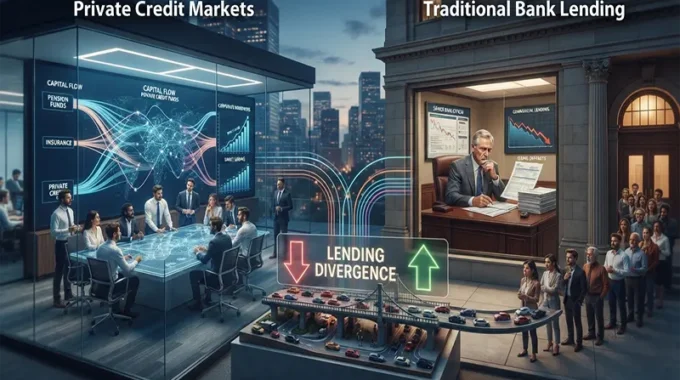
Corporate Funding Migration to Private Credit Markets and the Impact on Traditional Bank Lending

The post-banking-crisis era, paired with a prolonged higher-interest-rate environment, has permanently altered how corporations raise debt capital. For decades, commercial banks and public syndicated loan markets served as the undisputed gatekeepers of corporate finance.

Today, that landscape is undergoing a massive structural shift. A tidal wave of corporate funding is migrating away from traditional banking institutions toward private credit and direct lending funds. As private debt asset pools swell into trillions of dollars, traditional bank lending is being squeezed, forcing commercial institutions to fundamentally rethink their underwriting models, syndication desks, and corporate banking relationships.

Macro Drivers Fueling the Private Credit Boom

The rapid expansion of private credit is not a temporary market aberration; it is driven by powerful macroeconomic and regulatory forces.

  • Regulatory Squeeze on Commercial Banks: Following tighter post-crisis regulations (including Basel III and emerging Basel IV capital frameworks), holding corporate loans on bank balance sheets has become significantly


How Investment Banks Are Deploying Agentic AI Workflows for Automated Trade Accounting

For years, the financial services sector approached artificial intelligence with caution, relegating digital tools to passive generative chatbots or rigid, rule-based automation scripts. While these technologies assisted with drafting reports or sorting basic customer data, they remained fundamentally limited when applied to the high-stakes, high-volume environment of investment banking back-offices.

Today, that paradigm is shifting rapidly. Major investment banks are moving beyond simple automation to deploy autonomous agentic AI workflows. Unlike static software, agentic systems possess the capacity for multi-step reasoning, dynamic tool usage, and self-correction. By embedding these intelligent agents into trade accounting, financial institutions are transforming a historically labor-intensive, error-prone cost center into a streamlined, high-speed strategic engine.

From Rule-Based Automation to Autonomous Agentic Frameworks

To understand the magnitude of this transition, it is helpful to look at how back-office operations have evolved.

  • The Limits of Legacy RPA: Traditional Robotic Process Automation (RPA) and rigid macro scripts

How Adding a Co-Applicant Improves Property Loan Eligibility

We’ve all experienced this situation: staring at our dream home, getting all excited about it, but then being stopped by the question of loan eligibility. However, here’s an insightful tip: just maybe, a co-applicant will be your winning lottery ticket. Let’s analyze the situation.

Reasons for Bringing a Plus-One to Your Loan Application

You might question, “Why would having someone as a co-applicant result in such a big difference?” It’s basically the same as having one more person to help you carry something that is too heavy. More people means less effort, doesn’t it? Adding a co-applicant can potentially improve your overall financial image which banks crave watching.

Imagine that: by merging your salaries, you give a lender an authentic guarantee that monthly installments will not be a problem. In addition, if your co-applicant maintains his/her credit score reasonably, it will be a nice card thrown in the game.

Talking

When Disaster Strikes: Securing Fast Approval Personal Loans for Emergencies Online

Life is unpredictable, and when a financial emergency hits—be it an urgent medical bill, a sudden car repair, or an unexpected home disaster—time is of the essence. Waiting days for a traditional bank loan decision is simply not an option. This urgency has fueled the rise of the fast approval personal loans for emergencies online, a product designed for speed, convenience, and rapid access to cash.

The Digital Advantage: Why Online Loans are Faster

The core advantage of seeking an emergency loan online is the elimination of manual, paper-based processes. Modern online lenders, including banks, credit unions, and dedicated FinTech platforms, have streamlined the lending process into a few quick digital steps:

  1. Instant Pre-Qualification: Many online lenders allow applicants to pre-qualify by entering basic information. This step involves a “soft” credit pull, which does not affect your credit score, and provides an instant rate estimate.
  2. Paperless Application: The formal

Escaping the Cycle: Personal Loan Repayment Tips to Avoid Debt Traps

A personal loan can be a powerful financial tool, providing necessary funds for everything from home improvements to debt consolidation. However, mismanaged repayment can quickly lead to a debt trap—a vicious cycle where you constantly borrow to pay off existing debt, resulting in escalating interest and a feeling of financial hopelessness.

The key to unlocking the benefits of a personal loan without falling into this trap lies in smart planning and disciplined execution. Here are essential personal loan repayment tips to keep your finances on track and achieve debt freedom.

1. Master Your Budget and Spending

A personal loan should integrate seamlessly into your existing financial life, not strain it.

  • Create a Realistic Budget: Before taking the loan, you should have calculated whether the monthly payment (EMI) comfortably fits into your budget. If you haven’t, do it now. Track your income and all expenses—necessities, semi-necessities, and discretionary spending.
  • Prioritize